Friday, March 27, 2009

Cambodian and world heritage


Siam Reap , the best place of the world


Medley of diverse dishes provide taste of Myanmar in Cambodia

Written by Stephanie Mee
Wednesday, 25 March 2009

Phnom Penh restaurants Irrawaddi and Win Myanmar offer a taste of Myanmar hospitality and cuisine with signature dishes that are bound to make your mouth water

090325_21.jpg
Photo by: Tracey Shelton
Win Myanmar restaurant in Phnom Penh serves tasty fare.
Although not as internationally renowned as the fare in neighbouring countries such as Thailand, China or India, Myanmar cuisine is just as fresh, flavourful and varied as any other type of food in Asia.

The culinary tradition in Myanmar, formerly known as Burma, has been influenced over the centuries by its bigger neighbours, and more recently, England and Bangladesh, and this has resulted in a medley of diverse dishes, all with a distinct twist.

Typical dishes in Myanmar range from many types of noodle and rice dishes, stir-fried vegetables and meats, curries, fresh and spicy salads, crispy fried fish, sweet sticky rice with shredded coconut, and all manners of soup.

"Most Burmese food is fresh, such as the salads, soups and fish dishes, although some fried dishes can be a bit spicy, oily and salty at times," said Cho Cho, former Yangon resident, and owner of Irrawaddi restaurant in Phnom Penh. "That's why we try to attune our dishes to the customer's tastes. We try to change them just a bit so that they suit everyone's palate."

Cho Cho estimates that there are about 200 Myanmar nationals residing in Phnom Penh, and her restaurant appears to be a home away from home for many, as well as an assortment of Western and Asian clientele.

With some 72 dishes on offer, the menu at Irrawaddi reads like a crash course in the flavours of the diverse regions of Myanmar, with such options as fried bamboo shoots with garden peas and a crispy onion topping, ginger salad, fried bitter gourd and tea leaf salad.

"Tea leaf salad is very special in Myanmar," said Cho Cho. "Whenever you go to someone's house to visit, the host will often serve tea leaf salad to the guests, along with hot tea."

The tea leaf salad, or le ptet thow, at Irrawaddi is a combination of mild, moist green tea leaves; crunchy white beans; tiny, salty, dried shrimp; fresh tomatoes; fragrant garlic; toasted sesame seeds and a few roasted peanuts for good measure, all tossed in a light oil dressing.

Another popular signature dish at Irrawadi is Hilsa fish. Hilsa is an oily fish rich in omega-three fatty acids that is found only in the Bay of Bengal, and a few rivers in Bangladesh and Myanmar.

Cho Cho and her team at Irrawaddi import the fish from Myanmar and serve it piping hot and tender, in a rich stew of onions, lemongrass and gravy.

I want people to experience the authentic burmese style of hospitality.


"Most of the staff here is from Myanmar, and we have become like family," said Cho Cho. "At first they were nervous to serve people because they had no international serving experience, but I said to them: ‘Please maintain your own culture. Do what you did in your family, in your community,' I want people to experience the authentic style of hospitality."

Coming from a country that is renowned for its generous and welcoming treatment of guests, it is not surprising that the style of service at Irrawaddi is first rate, with no water glass falling below the halfway point nor a complimentary peanut dish remaining empty for long.

Win Myanmar is another restaurant in Phnom Penh that specialises in Myanmar cuisine, and although the atmosphere is not quite as cosy or visually stimulating as Irrawadi's, what they lack in decorative elements, they make up for in impeccable service and tasty Myanmar and Khmer cuisine.

Dishes at Win Myanmar include pork and chicken salads, catfish curry, Myanmar-style Biryani rice, and a special dish available every Sunday called mohinga.

Often called the national dish of Myanmar, mohinga varies from the north to the south of Myanmar, but a standard mohinga consists of rice vermicelli noodles in a thick fish soup, and contains garlic, onions, lemongrass, ginger, slices of banana tree stem, fish paste, chickpea powder and roasted catfish.

"Mohinga is typically a breakfast food, but can be eaten any time of day," said Soueng Vorn, a waiter at Win Myanmar. "We get many customers from Myanmar who come here for our mohinga special, and to sit and chat and enjoy their Sunday afternoon."

To enjoy the unique flavours of Myanmar in Phnom Penh head to Irrawaddi Myanmar restaurant, 24 Street 334 or Win Myanmar restaurant, 23 Street 110.

The circus is back in town

Written by Anita Surewicz
Thursday, 26 March 2009

Tini Tinou will bring its unique blend of local and international talent to the big top beginning Friday, with preview performances in Phnom Penh and a 4-day festival in April in Battambang.
090326_17.jpg
Photo by: Photos Supplied
This year’s Tini Tinou will feature high-flying trapeze acts, tight-rope walkers and an assortment of clowns and contortionists.

Feats of acrobatics, trapeze acts, tightrope displays, contortionists and the antics of clowns are set to dazzle and amuse at the upcoming Tini Tinou circus festival.

In its sixth year in Cambodia, Tini Tinou, meaning "here and there", will kick off in Phnom Penh on Friday before moving on to Battambang
for a four-day extravaganza.

Attracting a bevy of performers from around the globe, this year's festival, organized by the Battambang NGO Phare Ponleu Selpak (PPS), will feature 150 artists from 10 countries, giving the event a truly international flavour.

Renowned international performers from Canada, France, Australia, Germany and Japan descended on Cambodia this month to share their knowledge with young circus performers during two weeks of interactive workshops that took place prior to the commencement of this year's event.

"A big part of the 2009 festival is the training exchange between artists," said PPS artistic director Khoun Det.

While the majority of young artists who took part in the workshops were Cambodian, students from Laos, Romania and Japan also participated.

"There were approximately 50 students from PPS and around 10 from Phnom Penh's National Circus School, and around 30 students from overseas," said Dorothee Alemany, the organiser and coordinator of this year's Tini Tinou festival.

Angkorian roots
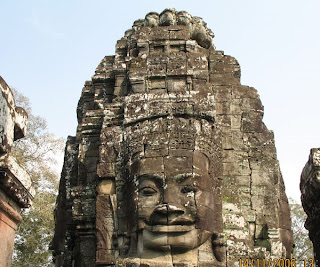
Performance art has a long history in Cambodia stretching back to Angkorian times, as evidenced by the 12th century bas-reliefs at the Bayon temple at Angkor Wat, which pay tribute to acrobats, contortionists, jugglers, musicians and animal handlers.

"Traditional circus has roots in 11th-century Cambodia. While the Asian circus is to some extent similar to the European circus, the main difference between the two is the accompanying music, which here is traditional Khmer music," said Khoun Det.

PPS took over organising the festival in 2007 from the French Cultural Centre, which launched the event in 2004, and opened it up to more international performers.

"The goal of the festival is to promote Asian circus arts and to share knowledge," said Alemany.

PPS, which literally means "Light from Arts", has its roots in the refugee camps on the Thai border, initially starting in 1986 as a project utilising visual arts as a means of encouraging creativity in young people to help them overcome the trauma associated with the Khmer Rouge regime and years of civil war.

Healing through creativity
"The idea was to give children in the camps something to do so that they wouldn't get bored and have something to think about other than war," said Alemany.

The project continued after its co-founders returned to Battambang following the 1991 Peace Accords. The project was formalised in 1994 when its organisers decided to create PPS.

The circus branch of the school began in 1998 with support from the National Circus School of the Royal University of Fine Arts in Phnom Penh and today has approximately 130 students, said Alemany.

Today the mission of the PPS school is to renew the circus by taking traditional Cambodian circus roots and mixing them with new international elements.

"Traditional Cambodian circus is very technical in nature. It is a chain of separate performances that follow one another. At PPS, we try to incorporate other elements such as stage management and artistic management into traditional circus performances - we bring music, stage and a more technical environment," Khoun Det said. "Contemporary circus is more about building one whole story with stage management."

THE GOAL ... IS TO PROMOTE ASIAN CIRCUS ARTS AND TO SHARE KNOWLEDGE.”


And to facilitate this stage management, training has been incorporated into the school's curriculum.

"Our new project is the training of technicians, which has been organised through Performing Philippines Educational Theater Association. A trainer from the Philippines came to Cambodia to train technicians from Battambang, PPS and the Performing Arts Department from Phnom Penh. He taught technicians how to prepare a show - lights, materials and sounds," Khoun Det said.

The focus of this year's Tini Tinou festival includes clowns and aerial acrobatics such as flying trapeze and tightrope displays.

Clowns from different countries will perform to display each country's unique jesters. In fact, the whole festival will be presented by two very different clowns - one Cambodian and one French, said Alemany.

"The Cambodian clown is more about speaking and making people laugh rather than about mime and gestures," said Khoun Det. "They wear sleeveless shirts and kramas, usually hang out in a fishing hut and spend their time trying to pick up girls."

"We are trying to make the traditional Khmer clown more international - we want them to do more than just speak," Khuon Det said, adding that PPS trains women to be clowns, an element that breaks with Cambodian tradition.

Another unique feature of this year's festival will be its guest of honour, the PA-RA-DA Foundation from Romania.

"We decided from last year to have a guest of honour at the festival, and we try to choose an organization that has a similar social mission to PPS, and PA-RA-DA seemed appropriate," said Alemany.

The foundation was created in 1996 by a French clown, Miloud Oukili, who started teaching workshops for children living on the streets after he arrived in Bucharest in 1992.

Uncertain future
But Tini Tinou is now in danger of extinction due to insufficient funding, and organisers say it may not return next year. This is the first time in the event's six-year history that a cover charge had to be introduced, creating the very real danger that the festival may not attract the usual numbers this year.

"There may be less people this year due to the cover charge. It is a risk that the NGO is taking, but because the circus is well-known now, it is a risk worth taking," said Khoun Det.

However, Alemany is quick to point out that the Khmer communities around the NGO in Battambang will be able to attend the performances for free.

"We will have different prices for Cambodians and the international community, but local communities will still have free access to the festival because we feel that they are our first audience," said Alemany.

Even though the festival is supported by a number of local and international organisations, Alemany says the current level of funding is not sufficient and that this year the circus will go over its allocated budget.

The Tini Tinou festival kicks off Friday with a show at the French Cultural Centre in Phnom Penh and continues Saturday with a parade
beginning on Street 13 (in front of Friends), continuing to the National Museum, down Sisowath Quay and culminating with a stage show at Wat
Botum.

In Battambang, the four-day festival running from April 2 to April 5 will comprise of three shows nightly and smaller performances by pre-professionals.

The cover charge for Friday's show at the French Cultural Centre in Phnom Penh is US$8 for general admission and $4 for students. In Battambang the cost of a one-night pass is 3,500 riel for Cambodians and $10 for foreign nationals. A three-day pass will cost $3 for Cambodians and $20 for foreign nationals. Children will be able to enter at the discount price of $4 for a one-day pass and $8 for a three-day pass.

Thursday, March 26, 2009

Mr. Alex Chantra.


http://everyday.com.kh/photogallery/photos/Entertainment/00806_alexchantra.jpg
he is the khmer singer, and a hand some khmer boy has started his work since 2005.
MOre detail:http://everyday.com.kh/photogallery/kh/Image.asp?code=1412

Miss; Dagn Molika

http://everyday.com.kh/photogallery/photos/Entertainment/00805_monika.jpgDownload Clip Here
she is the khmer star has started her work since 1999. Now she is 23 years old.
more detail: http://everyday.com.kh/photogallery/kh/Image.asp?code=1411


Miss Tep BoPrek, khmer singer.

http://everyday.com.kh/photogallery/photos/Entertainment/00804_teb-boprek.jpg

she is the kmer singer has started her work since 2005, now she is just 17 years old.
more detail: http://everyday.com.kh/photogallery/kh/Image.asp?code=1410